
If you searched brain fog menopause because you walked into a room and forgot why, welcome. You’re in very familiar company. Most women report memory or concentration problems during perimenopause, and those moments can feel unsettling, especially when they seem to arrive out of nowhere. (A review of recent evidence on cognitive problems in perimenopause reports that most women in the studies reviewed experienced memory or concentration difficulties.)
Brain fog menopause: what does it actually feel like?
It might be losing a word halfway through a sentence, walking into a room and having your purpose disappear, or opening the fridge with great intention and then nothing. You might reread the same paragraph, misplace your keys, or take longer to recall a name you know perfectly well.
If this is happening, it does not mean you are careless or not trying hard enough. Memory and concentration complaints are common during the menopause transition, though exactly how they show up varies from person to person, as the perimenopause cognition review sets out.

What research shows about perimenopause and memory
The most consistent findings are subtle changes in verbal learning and verbal memory. In everyday terms, that means taking in and recalling words, lists, and information someone has just told you. Some studies also find changes in processing speed, attention, or working memory, which helps you hold and use information for a short time. But findings in those areas are mixed, and not everyone experiences measurable changes. (The review of cognitive problems in perimenopause summarizes the strongest evidence and its limitations.)
The evidence points to subtle changes that may ease after the transition for many people, rather than the kind of progressive decline associated with dementia. A review of menopause and brain health describes cognitive performance changes that may normalize after menopause, which fits with a hormonal driver behind the fog rather than a permanent loss.
There’s another wrinkle: how foggy you feel does not always match how you perform on a cognitive test. In one study of 75 perimenopausal women, self-reported memory complaints were associated with some attention and working-memory measures, but not with verbal-memory test performance. Mood, sleep, and other symptoms also mattered. A test is a snapshot, not a verdict on whether your day-to-day experience is real. (The study on memory complaints and test performance during the menopause transition found that the relationship was not straightforward.)
Why might brain fog happen?
The hormonal change is the driver. Estrogen fluctuates and then falls during perimenopause, and estrogen receptors are concentrated in brain areas that handle memory and thinking, including the hippocampus and prefrontal cortex. Progesterone matters too: it breaks down into allopregnanolone, which acts on the calming GABA receptors that mood and sleep depend on, so when those hormones swing, thinking and mood swing with them. (The perimenopause cognition review describes hormone fluctuations and these brain regions; a review on menopause and brain health sets out how hormonal changes affect the brain.)
Other factors certainly add to it, and they sit on top of that hormonal shift rather than replacing it. Sleep broken by hot flashes or night sweats, anxiety, low mood, fatigue, stress, and other health issues all deepen the fog and all deserve attention in their own right. Thyroid problems, anemia, and sleep apnea are worth discussing with a clinician when symptoms fit. (The perimenopause cognition review links cognitive difficulties with sleep, mood, fatigue, and vasomotor symptoms; the National Institute on Aging’s menopause and sleep guide covers sleep problems, while MedlinePlus explains thyroid disease, and the National Heart, Lung, and Blood Institute explains anemia.)
Some medications can affect thinking, too, so it’s worth telling a trusted health professional what you take rather than stopping anything on your own. (The National Institute on Aging lists medication side effects among possible causes of memory problems.)
Is it early dementia?
It’s understandable to worry. Forgetting a word or why you opened the fridge can feel alarming, but it isn’t, by itself, proof of dementia. Perimenopausal cognitive changes are generally described as subtle and often temporary, while dementia involves a progressive decline that interferes with everyday activities. (The perimenopause cognition review describes cognitive changes during the transition; the National Institute on Aging explains the difference between common forgetfulness and signs of dementia.)
Now the part that deserves a straight answer, because you have probably heard it. Women make up roughly two thirds of people living with Alzheimer’s disease, and longer lifespan alone does not explain that difference. A review of female sex and Alzheimer’s risk through the menopause transition sets out why researchers keep looking at this stage of life: estrogen helps regulate how the brain uses glucose for fuel, and during perimenopause that system becomes less efficient.
The imaging work is the striking part. Women aged 40 to 60 showed lower brain glucose metabolism, reduced mitochondrial activity and more amyloid buildup in perimenopausal and postmenopausal stages than premenopausal women and than men of the same age, with the pattern strongest after menopause and independent of age and APOE genotype. That review walks through the imaging and what it does and does not prove.
What it does not prove matters just as much. This is observational and imaging evidence, not proof that menopause causes dementia, and no trial has shown that any hormone treatment prevents it. Most women who go through menopause never develop dementia, and the fog itself usually settles. So the useful message is not a countdown. It is that midlife is a genuinely good moment to look after the things that protect the brain, which are mostly the same things that protect the heart: blood pressure, blood sugar, sleep, movement, alcohol and smoking. The National Institute on Aging advises discussing memory concerns with a health professional, which is also worth doing if anything here feels personal or is getting worse.
What can help?
There isn’t one fix for every kind of brain fog. Start with the things that may be getting in the way of clear thinking, and bring persistent concerns to your doctor.
- Protect sleep where you can. If sleep has become a nightly negotiation, our guide to 10 reasons sleep isn’t working in perimenopause is a useful place to start, and so is why you keep waking at 3am. Sleep problems and night sweats are worth discussing with your health professional. (The National Institute on Aging’s guide to menopause and sleep offers information on sleep concerns during menopause.)
- Talk about the hormonal change itself. Hormone therapy replaces the hormones your body is producing less of, and it is the most effective treatment for troublesome hot flashes and night sweats, which are often what break sleep and thinking apart in the first place. It is not prescribed to treat memory complaints or to prevent dementia, and the North American Menopause Society’s position statement is clear on that. But easing the symptoms fragmenting your nights is a legitimate reason to raise it with your prescribing health professional. (The National Institute on Aging discusses options for hot flashes; the North American Menopause Society’s hormone therapy position statement does not recommend hormone therapy to treat cognitive complaints.)
- Notice alcohol, movement, and stress. The perimenopause cognition review includes limiting excessive alcohol and regular physical activity among general brain-health strategies, while noting they have not been specifically proven to treat perimenopausal brain fog. (The review of cognitive problems in perimenopause outlines these strategies and the limits of the evidence.)
- Give anxiety and low mood proper attention. You don’t have to grit your teeth through either. Cognitive behavioral therapy (CBT) and other behavioral approaches may be worth discussing with a health professional. (The Office on Women’s Health describes CBT and other approaches for menopause-related symptoms.)
- Keep up with general health care. Blood pressure and other health conditions are part of brain health, too. Regular movement and staying socially and mentally engaged support overall health, though they are not guaranteed brain-fog cures. (The perimenopause cognition review discusses treating health conditions and healthy behaviors as part of general brain-health strategies.)
If fatigue is part of your fog, our guide to perimenopause fatigue and why you’re so tired is coming soon. And if you want the bigger picture, read Perimenopause, explained.
Kind, practical tools for foggy days

You don’t need to “try harder” to remember everything. Make remembering easier:
- Keep a short list, and write things down as they come up.
- Use phone reminders for appointments and tasks.
- Give your keys one dependable home.
- Say someone’s name out loud when you meet them.
- Do one thing at a time when you can. Multitasking is not a personality test.
These are everyday supports, not a sign that something is wrong with you. The National Institute on Aging recommends practical memory aids and discussing concerns with a health professional.
When should you see a doctor?
Make an appointment if the changes are progressive, interfere with daily life, or worry you. Mention when they began, how often they happen, how you’re sleeping, any hot flashes or night sweats, mood changes, fatigue, health conditions, and what you take. Your clinician can help consider other causes, including thyroid problems, anemia, sleep apnea, depression, or medication effects. The National Institute on Aging recommends speaking with a health professional about memory concerns, and the National Institute of Neurological Disorders and Stroke describes sleep apnea and its effects.
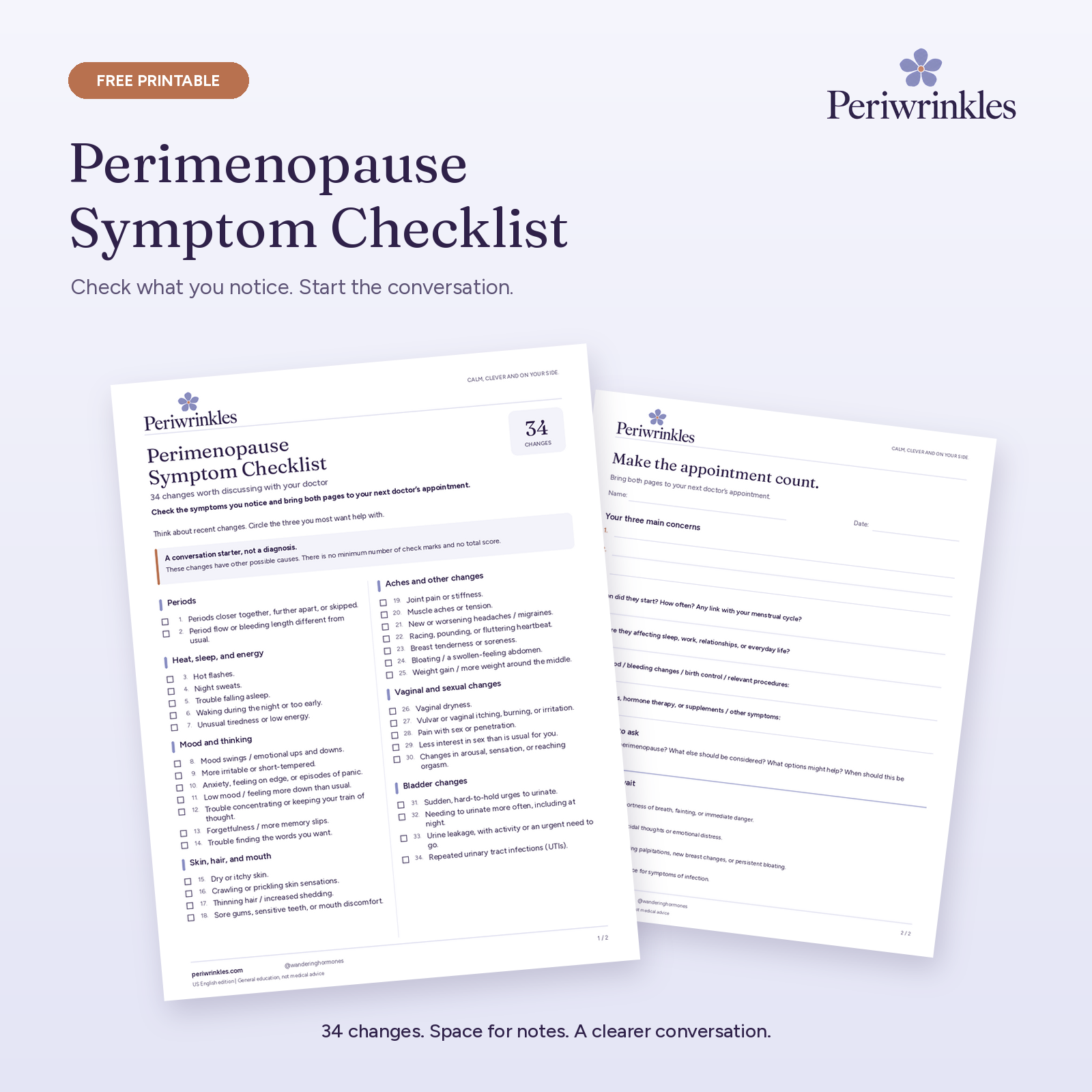
The free Perimenopause Symptom Checklist can help you note what’s happening and prepare for that conversation. You are not imagining it, not alone, not out of options.
Periwrinkles provides health information for education only. This article is not medical advice and does not replace care from your health professional. Talk with your doctor or prescribing health professional about your symptoms, concerns, and individual health needs.